How to prepare for a PhD interview in seven days
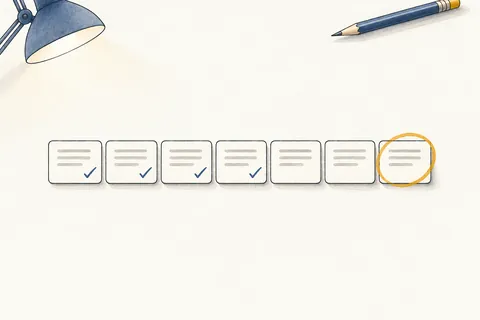
You do not need weeks of preparation. You need a clear order of work. This plan spreads the useful steps over seven days and ends with a one-page sheet you can trust on the day.
On this page9 sections
- What should you find out before you start?
- What does the seven-day plan look like?
- How should you practise answering out loud?
- What goes on your one-page sheet?
- How do you handle nerves?
- How do you set up a good video interview?
- What should you do on the day?
- What if you have to give a presentation?
- What mistakes should you avoid?
What should you find out before you start?
Good preparation starts with knowing what you are preparing for. Send a short, polite message to the department or the professor's assistant, or re-read the invitation, and find out:
- Who will be on the call, and for how long.
- Whether it is a conversation only, or also a presentation, a technical task or a written exercise.
- Which platform they will use (Zoom, Google Meet, Microsoft Teams or something else).
- Whether they will ask you to discuss a particular paper or project.
The answers decide how you spend the next seven days.
What does the seven-day plan look like?
Day 7 and day 6: research the professor and the lab
Read the lab website, scan the last three to five years of papers, and read two or three of them properly. Write one summary sentence and one question for each. Our guide on how to research a professor walks through the method.
Day 5: build your story bank
Most interview questions can be answered with one of five stories from your own work. Write a few bullet points for each:
- Your thesis or main project.
- A technical challenge you solved.
- Something that went wrong and what you learned.
- Teamwork or supervision, such as helping a colleague or leading a part of a project.
- Why you want a PhD and why this lab.
For each story use the same shape: context, what you did, the result, what you learned.
Day 4: learn the question families
Read through common PhD interview questions. You are not memorising answers. You are noticing which stories fit which question.
Day 3: practise out loud
Say your answers to an empty room, a friend or a practice tool. Record one answer and listen back. You will notice filler words, answers that run too long, and parts that are unclear. Fix those, then repeat.
Day 2: prepare your questions and your setup
Write five to eight questions to ask the professor. Then check your technology: camera at eye level, a plain background, good light on your face, working microphone or headset, a stable connection and a second way to join (for example your phone) in case something fails.
Day 1: make a one-page sheet and rest
Put the essentials on a single page: your key facts (degrees, dates, paper titles, numbers), your story bank in bullets and your questions. Read it once. Then stop. Sleep matters more than another hour of review.
If you have fewer than seven days
Do these in order and leave the rest. First, confirm the format and the time zone. Second, read two recent papers and write one question for each. Third, prepare a two-minute account of your thesis or main project and say it aloud. Fourth, say three more answers aloud, for example "tell me about yourself", "why this lab" and one story about a difficulty. Last, make the one-page sheet and test your technology. Two days of focused work on these beat seven days of unfocused worry.
How should you practise answering out loud?
Silent preparation feels productive but does not train the thing you will actually do, which is speak clearly while thinking. Use a simple loop:
- Pick one question and answer it from your bullet points, not from a script.
- Time it. Most answers work best between ninety seconds and two minutes. If you go past three, you are telling the whole story instead of the useful part.
- Record it on your phone and listen once. Note filler words, long pauses, and any sentence you could not follow yourself.
- Fix one thing and answer the same question again. One improvement per round is enough.
- Change the question slightly and answer again, so you learn to adapt a story instead of reciting it.
Two or three rounds of this on your five stories does more than an hour of reading. If you can, practise with a person or a tool that asks follow-up questions, because real interviewers interrupt and dig. The guide on practising with a general chatbot or with Norielo compares a general chatbot with our own app, Norielo, and gives a prompt you can use.
What goes on your one-page sheet?
The sheet is a memory aid, not a script. A good layout fits on one side of paper:
- Top line: the professor's name, the date and time with the time zone, and the platform link.
- Key facts: your degrees and dates, your thesis title, two or three numbers from your results, and the titles of the papers you want to mention.
- Five stories: one line each, with a keyword that reminds you of the result.
- Their work: two recent papers with your one-sentence summary and your question for each.
- Your questions: three to five, most important first.
How do you handle nerves?
The guide on handling nerves goes further than this section.
Some nervousness is normal and even useful. What helps in practice is making the start easy: write the first sentence of your "tell me about yourself" answer and know it well, because a calm first minute settles the rest. Slow your speaking pace on purpose, pause before you answer, and remember that the professor is also evaluating whether they would enjoy working with you. If your mind goes blank, say "Let me think about that for a moment" and take a breath. Most interviewers will read that as composure, not weakness.
How do you set up a good video interview?
For a full checklist, see the guide on online PhD interviews.
- Place the camera at eye level and sit about an arm's length away, with your face lit from the front.
- Use a headset or earbuds to avoid echo, and test them with a friend or a recording.
- Choose a quiet room, tell the people you live with, and silence notifications on every device.
- Close other programmes and tabs, and plug in your laptop.
- Have a second way in: the meeting link on your phone and the interviewer's email address.
What should you do on the day?
- Join five minutes early and check that sound and video work.
- Keep water nearby and close everything that can make a noise.
- Look at the camera when you speak, not only at the screen.
- If you do not understand a question, ask for it to be repeated or rephrased.
- Pause before answering. A two-second pause reads as thoughtful, not unsure.
- Take brief notes of anything you want to ask or follow up on.
If you want to keep notes in view during the call, read can you use notes in an online PhD interview? first.
What if you have to give a presentation?
Keep it short and clear: a minute on who you are, the main project in the middle, and a closing slide with your interests and how they fit the lab. Fewer slides, bigger figures, less text. Rehearse with a timer and leave room for questions, because the discussion usually matters more than the slides.
What mistakes should you avoid?
- Praising the lab without specifics. "Your work is fascinating" is weaker than naming a paper and a question about it.
- Memorising full answers. They sound stiff and fall apart when the question changes.
- Talking for five minutes. Long answers lose people. Offer to go deeper.
- Hiding gaps. Saying "I have not worked with that yet, but here is how I would approach it" is better than bluffing.
- Forgetting to follow up. A short thank-you email keeps the conversation going.
Frequently asked questions
What is the most important part of preparing for a PhD interview?
Understanding the professor's recent work and being able to connect it to your own background in specific terms. Generic enthusiasm is easy to spot, specific interest is not.
Should I memorise my answers?
No. Memorised answers sound stiff and break when the question changes. Memorise your key facts and examples instead, and let the words come naturally.
What should I do the night before?
Read your one-page sheet once, check your camera, microphone and internet connection, set out what you need, and sleep. Do not cram new material.