How to answer "tell me about yourself" in a PhD interview
The first question of a PhD interview is often the least specific: "tell me about yourself". A clear one-minute answer sets a calm tone for everything after it. This guide gives a structure, an outline and ways to practise.
On this page7 sections
Why do interviewers start with "tell me about yourself"?
Answer it in about a minute: who you are now, the two or three steps that led you here, and what you would like to do in this group. It sounds like small talk, but the question has a job. It lets the interviewer hear how you present your own work, it gives both of you a few minutes to settle, and it shows what you think is important about your story. They are not asking for your whole life. They are asking: who are you as a researcher, and why are you sitting in this interview?
Because it comes first, the answer sets the tone. A clear, calm one-minute answer makes the rest of the conversation easier. A long, wandering one makes it harder, for you and for them.
What structure works?
A simple shape is present, past, future. It keeps you on research, and it ends on the professor's own programme, which is the right place to finish.
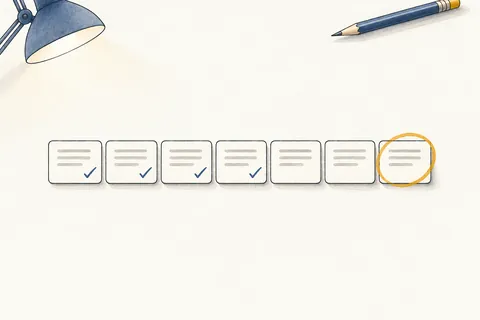
- Present. Who you are now, in one sentence: your degree, your university and the area you work in.
- Past. Two or three steps that led you here: a thesis, a project, a paper, an internship. Choose what points toward this PhD, and for each give one result or one thing you learned.
- Future. What you want to work on in the PhD and why this group, naming one concrete thing from the professor's recent work.
Aim for about a minute, or a minute and a half. Practise with a timer, because most people run longer than they think. The answer does not need to include everything. If the interviewer wants more, they will ask.
What does it sound like?
Here is an outline with made-up details. It is there to show the shape, not to be read out or memorised. Your own facts will be different, and they should be.
"I am a final-year master's student in [field] at [university]. My work has been on [area].
My interest started in my bachelor's project, where I [what you did]. In my thesis I [what you did] and found [result], which made me want to understand [deeper question]. I also [second experience, such as a paper or internship], where I learned [skill].
That is why I am interested in your group. I read your recent paper on [topic], and I would like to work on [specific direction], where my experience with [skill or data] could be useful."
Notice what is missing: a list of every course, a history of school, long personal stories and generic adjectives. What is there are facts, results and a direction.
How do you adapt it to the interview?
- Matching the group. Change the last part for each professor, so that it points at their work. The first parts can stay the same.
- Matching the level. For a master's interview, you can spend a little more time on your academic background. For a PhD interview, spend more time on research and on what you want to do.
- Matching the format. For a short call, use the one-minute version. If the interviewer says "take a few minutes", use the longer one, and finish with a question about their group.
Prepare three versions: one sentence, one minute and three minutes. They are all the same story at different lengths. The guide on explaining your research shows how to build the middle part.
What should you avoid?
- Reading your CV aloud. They have it in front of them.
- Going too far back. Start at the point where research begins, usually your bachelor's thesis or a first project, not primary school.
- Too much personal detail. A short, human sentence is fine, but keep the focus on your work.
- Overclaiming. Say what you did and what the team did. A professor can ask about any detail.
- Apologising. Phrases such as "my English is not good" or "my experience is small" give the interviewer a reason to doubt you. Say what you have done and stop.
- A memorised speech. If you sound like you are reciting, you will lose the thread when you are interrupted.
How do you practise in English?
Write three or four bullet points, not a full script, and say the answer aloud. Record yourself on your phone, listen, and fix the places where you rush, repeat words or use sentences that are too long. Then practise with a person: a friend, a teacher or a colleague. Ask them to interrupt you, as an interviewer sometimes does, and finish the answer anyway.
If English is not your first language, a clear and slightly slower pace is a strength. Speak in short sentences and use words you are comfortable with. It is much better to be easy to follow than to sound impressive.
What if you are interrupted or lose your place?
An interviewer may stop you after the first sentence and ask about something in it. That is a good sign: they are interested. Answer the question, and if you want to return to the main line, you can say "Going back to what I was saying about [topic]". If you lose your place, take a breath, say "Let me start that point again", and continue. Nobody expects a perfect delivery. They want to hear how you think and speak, and the rest of the conversation matters more than the first minute.
After this opening, the common questions come next. The guide on PhD interview questions walks through them one by one.
Frequently asked questions
How long should my answer be?
About a minute to a minute and a half is a good target. If the interviewer asks for more detail, they will say so.
Should I mention personal things?
One short, human sentence is fine, but keep the focus on your academic and research story.
What if English is not my first language?
Speak in short sentences, at a clear and slightly slower pace, with words you are comfortable with. Being easy to follow matters more than sounding impressive.