How to write a research proposal for a PhD application
A research proposal is a short plan for the research you would do. This guide shows what it is for, which sections to include, what a good question looks like and which mistakes make it weak.
On this page6 sections
What is a research proposal, and who asks for it?
A research proposal is a short plan for the research you would like to do in your PhD. The department uses it to see whether you can think like a researcher, whether your question is realistic, and whether it has someone who could supervise it. It is not a contract. The University of Manchester, for example, says that when you submit a proposal you are not committing yourself to its precise detail or method, and that you can refine it with your supervisors after you are accepted.
Not every programme wants one. Many research programmes in the United Kingdom, and some elsewhere, ask for a proposal, and the Manchester page says it is crucial in the assessment of an application. Many programmes in the United States ask for a statement of purpose instead; the PhD in social welfare at UC Berkeley, for example, requires a statement of three to five pages and does not ask for a research proposal. The two documents do different jobs. A statement of purpose is about you and your path. A proposal is about a project. The programme's application page says which one it wants, and often how long it should be, so read it first. If you have already written a thesis proposal in Iran, that experience helps, but an application proposal is usually much shorter and must persuade a stranger within a few minutes.
What should you do before you write?
- Read the instructions. Look for the word limit, the required sections and whether a reference list counts towards the limit. Manchester says typical proposals range between 1,000 and 1,500 words and tells applicants to check their school's own guidance, so never assume a number.
- Read the group's recent papers. A proposal that could be sent to any department shows that you have not looked at this one. The guide on researching a professor shows a quick way to do it.
- Talk to a possible supervisor. Manchester advises contacting an academic member of staff to discuss your proposal before you submit it. This helps you refine the idea, and it helps the university see whether it has the right supervisors. The guide on emailing a professor has templates for the first message.
- Choose one question you can finish. A PhD is a few years of work. A project that needs ten years, a huge dataset you cannot get or equipment the department does not have is a risk, however interesting it is.
What sections should a proposal have?
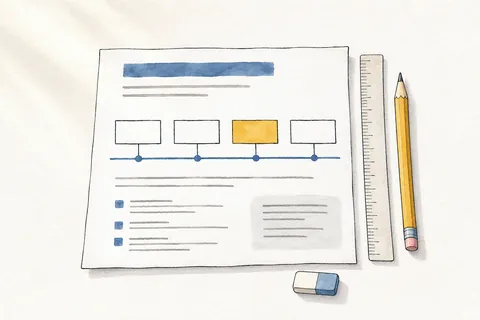
There is no single template, and conventions differ between subjects, but the Manchester guidance lists the parts that most proposals contain. For a proposal of about a page and a half, this is one sensible order, with a rough idea of how much space each part needs:
- A working title. It can change later. Make it precise.
- Introduction (a short paragraph). The subject, the problem and why you want to pursue it.
- What is already known and the gap (about a quarter of the text). A short review of the key literature and theories that leads to something that is not yet known or not yet done. This is the part that shows you know the field.
- Aims and research questions (a few lines). One main question and perhaps two sub-questions. Everything else in the proposal should serve them.
- Methods (about a quarter to a third of the text). What data, materials or experiments you need, where they are, how you will get access to them and how you will analyse them. Name the real method, not "I will use modern techniques".
- A plan and timetable. The stages of the work and what you expect to finish each year, with the main risks and what you would do about them.
- Why it matters. What would be new, and who would use it. One honest paragraph is better than a list of grand claims.
- References. The few key works you have really read.
What does a good research question look like?
A good question is narrow enough to answer, important enough to care about and clearly connected to what the group does. The simplest way to improve a draft is to make the question more specific. Compare these pairs:
- Too broad: "I want to study deep learning for medical images." Better: "Can the uncertainty estimates of a segmentation model be used to flag the scans on which it is likely to be wrong, and how well does this hold when the scanner changes?"
- Too broad: "I want to study online learning in schools." Better: "How do teachers in lower secondary schools in [city] use feedback from an online practice platform to change what they teach, and what stops them?"
The better versions name a method, a setting and a thing that could turn out to be true or false. If you cannot say what result would surprise you, the question is probably still too vague.
What mistakes make a proposal weak?
- A topic instead of a question. "Climate and cities" is a subject. A proposal needs something you could find out.
- A literature review without a gap. Summarising what others have written is not enough. Say what is missing and why your project fills it.
- Vague methods. "Qualitative methods" or "machine learning" is not a plan. Say which, on what, and why this choice.
- Too much. Three questions and four methods in fifteen hundred words read as a wish list. A modest plan that can be finished is more convincing.
- No timetable and no risks. They show that you have thought about doing the work, not only about the idea.
- Copying someone else's project. Building on the professor's work is good. Repeating one of their papers is not a proposal.
- Letting a tool think for you. A language tool can improve your English, but the question, the gap and the plan must be yours. You will be asked about them aloud.
What happens after you submit it?
The proposal often becomes the starting point of the interview. The University of Cambridge says that departments use interviews to learn about your background, motivation and potential, and to discuss your research proposal, including how feasible it is and what resources it needs. So you should be able to explain every sentence of it aloud, defend your choice of method and say what you would do if your first approach failed. The guide on explaining your research in an interview shows how to practise that, and the guide on PhD interview questions lists the questions that follow.
If you are admitted, expect the proposal to change as you read more and as your supervisors advise you. That is normal. A proposal was never meant to lock you in.
Frequently asked questions
How long should a research proposal be?
Follow the programme's limit. As one example, the University of Manchester says that typical proposals range between 1,000 and 1,500 words and tells applicants to check their school's own guidance.
Do I have to follow my proposal if I am admitted?
No. Universities such as Manchester say that you are not committing to the precise detail or method, and that you can refine the proposal with your supervisors.
Is a research proposal the same as a statement of purpose?
No. A statement of purpose is about you, your path and your goals. A proposal is about one research project. Some programmes ask for one, some for the other and some for both.